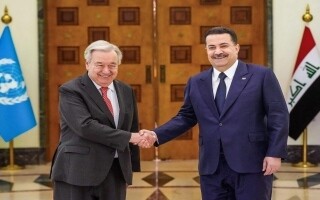
United Nations Secretary-General António Guterres announced on Saturday in Baghdad the end of the United Nations Assistance Mission for Iraq (UNAMI) after 22 years of its establishment, considering the country a "normal state" as it transitions to a new phase of stability. The closure of the United Nations Assistance Mission for Iraq - UNAMI, was at the request of the Iraqi government, after more than two decades of providing support and advice during the political transition period that followed the U.S. invasion and occupation of Iraq in 2003, which ousted former President Saddam Hussein's regime. Guterres said during a ceremony marking the end of UNAMI's work: "The United Nations Assistance Mission for Iraq had the honor of working side by side with the Iraqi people," stressing that the end of a political mission does not mean the end of the United Nations' role in the country. He added that "the United Nations will continue to support the Iraqi people on its path towards peace, sustainable development, and human rights". Various United Nations agencies and programs will continue their work in Iraq to support development efforts. During a press conference in Baghdad with Prime Minister Mohammed Shia' al-Sudani, Guterres said: "There is one thing the world must understand, and that is that Iraq is now a normal state, and the relations between the United Nations and Iraq will be normal relations with the end of UNAMI's mission." He said: "The United Nations is proud to have played a role in this period of Iraq's history." In turn, al-Sudani said that "the end of UNAMI does not mean the end of the partnership between Iraq and the United Nations, but rather the beginning of a new chapter in the areas of development, inclusive economic growth, and advice". The mission was established by a decision of the UN Security Council in 2003 at the official request of the Iraqi government, before its mandate was expanded four years later and renewed annually. Shortly after its establishment, the United Nations headquarters in Baghdad was attacked by a car bomb on August 19, 2003, which killed the first Special Representative of the Secretary-General in Iraq, Sergio Vieira de Mello, along with 21 other people. UNAMI's mandate included providing advice to the Iraqi government in the areas of political dialogue and national reconciliation, assisting in organizing elections, and supporting security sector reform. In recent years, with Iraq regaining a degree of stability and gradually returning to normal life, Iraqi authorities deemed there was no justification for the continued presence of a United Nations political mission in the country.